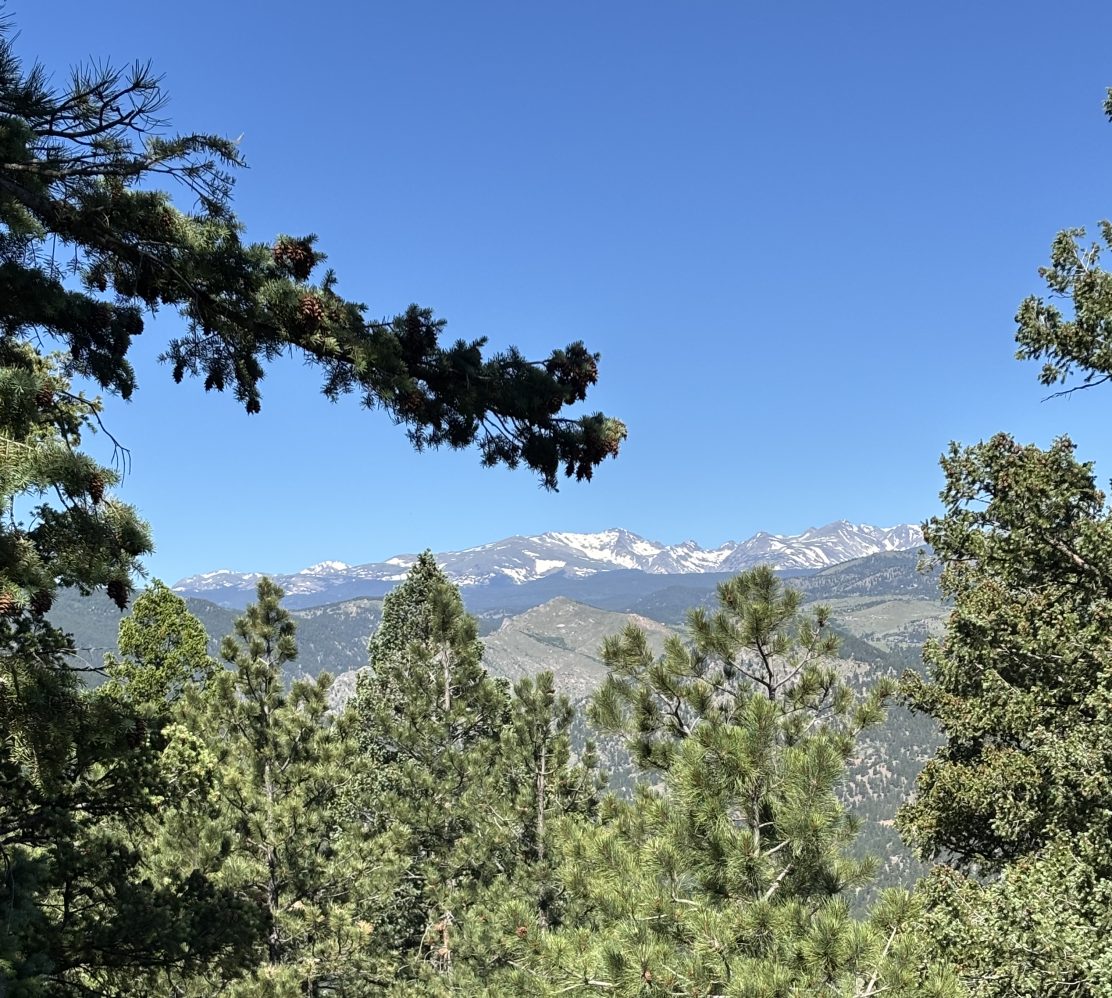

I spent my summer searching for beauty. It was an important quest as I faced the countdown to an empty nest. I knew I could spend my entire summer grasping and grieving for what I believed I was losing, or I could spend it looking for the gifts right in front of me. So I made it my goal to regularly seek out beauty and, when possible, take photos of something that made me grateful or inspired awe.
Some days I took photos of the majestic mountains of Colorado. Other days, I reveled in water lilies or a vivid coral delphinium. I found beauty in the stories of C.S. Lewis’ Chronicles of Narnia and in L’Engle’s Wrinkle in Time. I took photos of the summer-long mess that Settlers of Catan made of my dining room table, and I giggled at my weirdo dog as she lay sleeping with her head halfway down the couch. And I sat with my older dog in the days before she passed.
In the midst of all this documenting, I was leaning into the idea of beauty and its connection to God.
Sarah Clarkson, in her brilliant book This Beautiful Truth writes:
“My deep belief is that beauty has a story to tell, one that was meant by God to speak to us of his character and reality, meant to grip our failing hands with hope. We know God when we behold his beauty, when his goodness invades the secret rooms of our hearts.”
This became true for me over the course of the summer. As I searched for beauty and gratitude, I found them. It really wasn’t that hard. Each day, the sun rises anew in the east and west echoes back with oranges, purples and blues. People laugh. Cashiers make silly conversation but also share something honest about themselves. As I began to see what was already in abundance in this world, God’s goodness took hold of my heart. His kindness, His faithfulness and His call for me to fight back against cynicism began to take root. I knew God better at the end of the summer because I had spent my time searching for beauty. That search helped me identify a counterfeit version of God that I had been following.
That’s the thing about counterfeits…You don’t train to spot a counterfeit by studying all the different ways something can be fake. You recognize a counterfeit once you are so familiar with the real thing. Jesus describes this in John 10: 4-5. His sheep follow Him because they know His voice. They don’t follow a stranger because thy don’t recognize the stranger’s voice.
Counterfeit versions of God can be subtle. They sound mostly right, but they distort His character. We might believe that asking questions means we lack faith, even though Job is described as a man who feared God and the book of Job shows that he was full of questions. We might confuse forgiveness with the absence of accountability, yet Jesus told the woman caught in adultery to “go and sin no more”. Perhaps, like me, you’ve equated cynicism with discernment. They are both ask questions, seeking after truth. Yet cynicism doesn’t produce hope, it assumes the worst before we’ve even searched out what is true. Discernment looks for truth but makes room for what is good.
As my summer began, I had the choice to face my future, assuming the worst of what my life would look like when my kids moved out. By searching for beauty and awe, I found that God planted seeds of hope each time I saw evidence of His continued goodness in my life. I learned that assuming the worst isn’t what God intended for me, he wanted me to make room for what is
For beauty comes to us all in moments that unravel our cynical surety as our hearts seem to come apart at the touch of some odd slant of light on an evening walk. Or we hear the strained thread of some beloved old music that seems to break the spell of doubt. We read a novel, a story of someone who forgave or fought or hoped and we feel something stir to life as precious, as fragile, as urgent as a newborn child within us. Sarah Clarkson
God created beauty in the world to awe us, inspire us and overwhelm us with knowledge of Him. Don’t settle for a counterfeit that suggests nostalgia is the best we have to look forward to, or that people will let us down. Jesus assured us that He came that we may have life to the full.
So how do we protect ourselves from counterfeit versions of God?
- Spend time with God to know Him more. I’m not talking about picking up another study written by a well-known theologian (although that isn’t a bad thing!). I’m referring to sitting quietly, breathing deeply, and inviting God’s presence. Read a verse or chapter of the Bible, then pause and think about what you just read and what it reveals about God’s character. If reading your Bible raises more questions, GREAT! That leads me to number two.
- Ask the questions. Look at Bible commentaries, or find a church leader you trust. If a church leader doesn’t encourage questions, find another church leader. The Bible is filled with people who ask questions, especially of God. God isn’t afraid of your questions and your church leader shouldn’t be either.
- Pray. Ask God for things. Little things and big things. Know that God can say no, but you won’t know until you ask. Pray about your questions and ask God to provide leaders to help you work through them. Pray for your kids, your spouse or your parents. Pray for the parking space. Put yourself in a position to pray about the things that matter to you and pay attention to how God responds.
- Look for beauty and awe. I promise you, when you look, you will find them. Near me, the trees are currently awash in gold, and each day is a stunning reminder that God works in seasons. God continually reminds us that this, whatever this is, will also pass. Look up in the sky at night and be amazed at the enormity of our world.
- Pay attention to the fruit. Are your daily practices and the things you’re learning moving you toward the fruit of the Spirit of love, joy, peace, patience, kindness, goodness, faithfulness, gentleness, and self-control? The truth of who God is should ultimately produce His character in us. God’s not promising us an easy life, but following Him, being discipled by Him, does mean that we look more like Him. If what you’re being taught consistently produces fear, shame, a need to control, or an unwillingness to love others well, it’s worth asking what is influencing you.
Being intentional about looking for beauty became a bit of a habit this summer. God opened my eyes to hope and possibilities that I might otherwise have missed. And at the end of that season, I knew His character better and the seeds He planted began to take root. God’s invitation to “taste and see that the Lord is good” is open to us all.
